
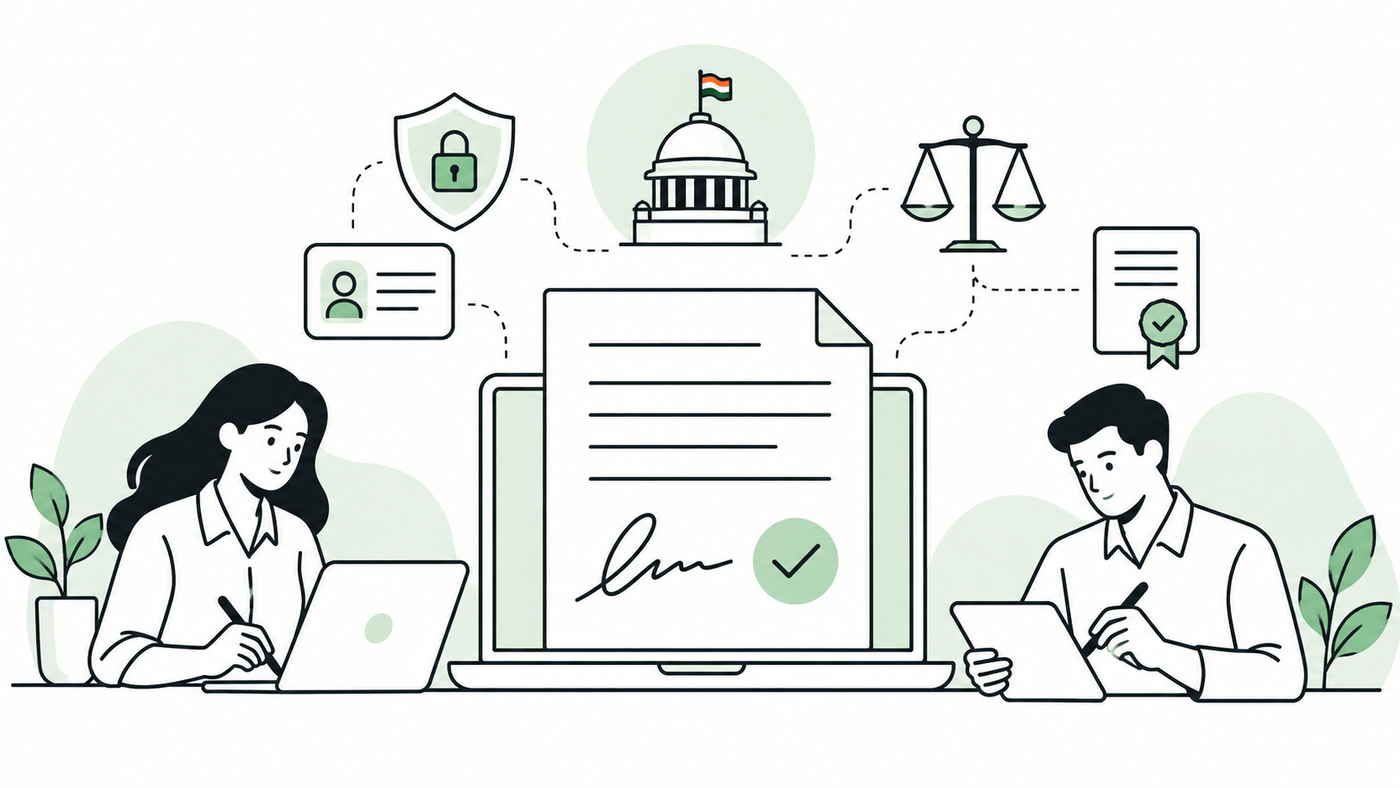
Can you sign a contract without printing a single page? In India, the answer is often yes. Electronic signatures are legally recognized under certain conditions, but not every method of signing a document has the same legal status.
From employment agreements and business contracts to everyday approvals, electronic signing is changing how people handle paperwork.
But an important question remains: What actually makes an electronic signature legally valid in India?
In this guide, we'll explain India's electronic signature laws, the difference between electronic and digital signatures, which documents can be signed online, and how to keep digital agreements secure and trustworthy.
1. Are Electronic Signatures Legal in India?
Yes. Electronic signatures are legally recognized in India when they meet the applicable requirements of the Information Technology Act, 2000.
The IT Act provides the legal foundation for electronic records, digital signatures, and electronic contracting.
Several provisions are particularly important:
- Section 3: Recognizes the authentication of electronic records through digital signatures.
- Section 3A: Provides for electronic signatures using reliable techniques specified under the legal framework.
- Section 4: Establishes legal recognition of electronic records.
- Section 5: Provides legal recognition for qualifying electronic signatures.
- Section 10A: Clarifies that contracts cannot be denied enforceability merely because electronic means were used in their formation.
However, these provisions do not mean that every typed name, pasted signature image, or online checkbox automatically qualifies as a legally recognized electronic signature.
A contract must also satisfy other applicable legal requirements, including consent, capacity, lawful purpose, and any document-specific formalities.
2. Electronic Signature vs Digital Signature: What's the Difference?
The terms electronic signature and digital signature are often used interchangeably, but they are not technically identical.
What Is an Electronic Signature?
An electronic signature is a broad term describing electronic methods used to indicate approval or authenticate a document.
Common examples include:
- Typing a name into an agreement.
- Drawing a signature using a touchscreen.
- Inserting a scanned handwritten signature.
- Approving a document through an online workflow.
- Signing through an authorized electronic signature service.
These methods may help demonstrate consent, but their legal status depends on the method, transaction, and applicable law.
What Is a Digital Signature?
A digital signature uses cryptographic technology to authenticate a document and detect changes after signing.
It typically involves:
- A private cryptographic key.
- A corresponding public key.
- A digital certificate.
- A cryptographic hash of the document.
- A verification process.
In India, legally recognized digital signatures operate within the applicable framework overseen by the Controller of Certifying Authorities (CCA).
Electronic vs Digital Signatures: Comparison
Feature
Simple Electronic Signature
Certificate-Based Digital Signature
Signing method
Typed, drawn, or electronically approved
Cryptographic signing
Identity verification
Depends on the workflow
Certificate-linked verification
Tamper detection
Not inherent
Cryptographically supported
Certificate required
Not necessarily
Yes
Legal status
Depends on applicable requirements
Recognized when statutory conditions are satisfied
Common use
General approvals and workflows
Formal and regulated signing processes
Key takeaway: Every digital signature is a type of electronic signature, but not every electronic signature is a cryptographic digital signature.
3. How Does a Legally Recognized Digital Signature Work?
A secure digital signing process involves more than placing a signature on a PDF.
Step 1: Prepare the Document
The document is uploaded or generated electronically.
The signer should be able to review the complete document before approving it.
Step 2: Verify the Signer's Identity
Depending on the signing method, identity verification may involve an authorized e-KYC process, a digital certificate, or another approved authentication mechanism.
Step 3: Capture Consent
The signer reviews the document and explicitly authorizes the signing action.
Step 4: Apply the Digital Signature
The authorized signing system applies a cryptographic signature associated with the document.
Step 5: Verify and Preserve the Document
The signed document can be checked for integrity and signature validity.
Relevant signing records and verification evidence should be retained.
Important: Receiving an OTP or completing identity verification alone does not mean a document has been digitally signed. The authentication process must be connected to an actual signing operation.
4. Which Documents Can Be Signed Electronically in India?
Many ordinary business documents can be executed electronically, subject to the relevant legal requirements.
Examples include:
- Employment agreements.
- Non-disclosure agreements (NDAs).
- Freelance contracts.
- Vendor agreements.
- Service agreements.
- Commercial contracts.
- Business approvals.
- Purchase agreements.
- Certain consent forms.
However, the signing method and other legal formalities must be appropriate for the particular transaction.
Documents That May Require Special Treatment
Some documents are subject to exclusions, restrictions, or additional formalities.
These may include:
- Wills.
- Certain powers of attorney.
- Certain trust documents.
- Certain negotiable instruments.
- Documents involving the sale or transfer of immovable property.
- Agreements requiring stamping, witnessing, notarization, or registration.
The First Schedule of the IT Act has been amended over time. The current schedule and the specific law governing a transaction should be checked rather than assuming every document in a broad category is excluded.
Remember: Electronic signing does not automatically replace stamp duty, registration, witnessing, or other statutory requirements.
5. Is Aadhaar Mandatory for Electronic Signatures?
No. Aadhaar is not universally mandatory for every electronic signature in India.
India's regulated electronic signing framework supports approved authentication and eSign mechanisms.
Aadhaar-based eSign is one recognized approach, but other approved methods may also be available through authorized providers.
The appropriate method depends on the signing service, identity verification requirements, and the applicable regulations.
Users should understand how their identity information is processed and what consent they are providing.
6. What Makes a Digital Signature Secure?
A trustworthy digital signing process should address four essential elements.
Identity
The signing process should establish who is signing and whether the person has the authority to approve the document.
Document Integrity
Cryptographic verification can help establish whether a signed document has been modified after signing.
Timestamp
Reliable timestamps help establish when a signing event occurred.
Where appropriate, trusted timestamps and long-term validation information can support later verification.
Audit Trail
A useful audit trail may include:
- Document identifier.
- Signing event details.
- Authentication events.
- Consent records.
- Signing timestamps.
- Relevant verification information.
An audit trail strengthens accountability, but it does not automatically replace legally required identity verification or cryptographic signing.
7. Can Electronically Signed Documents Be Used as Evidence in Indian Courts?
Yes. Electronic records can be admitted as evidence in Indian legal proceedings, subject to applicable evidentiary requirements.
The Bharatiya Sakshya Adhiniyam, 2023 addresses electronic and digital records, including their admissibility and proof under Sections 61–63.
An electronic document is not automatically inadmissible simply because it was created or signed digitally.
However, its authenticity, integrity, and evidentiary foundation may need to be established.
This is one reason why reliable authentication, document integrity checks, and preservation of signing records are important.
8. Why Are Businesses Moving Toward Electronic Signatures?
Traditional paperwork often requires multiple manual steps.
A document may need to be printed, signed, scanned, emailed, and stored before the process is complete.
Electronic workflows can simplify these activities.
Less Printing
Digital documentation can reduce unnecessary printing and paper consumption.
Faster Workflows
Documents can be reviewed and approved remotely without waiting for physical delivery.
Easier Organization
Digital records can be easier to search, retrieve, and manage when an appropriate document management system is used.
Better Traceability
Well-designed electronic signing systems can maintain useful records of document approvals and signing events.
More Flexible Collaboration
Businesses can work with employees, clients, and partners across different locations.
However, digital systems also consume energy and require responsible data management. Their environmental benefits depend on how they are implemented and used.
9. How PurelySustain Envisions the Future of Paperless Documentation
Paperwork is still part of everyday life.
We use documents to start jobs, establish partnerships, approve services, manage businesses, and formalize agreements.
Yet many document workflows remain unnecessarily complicated.
At PurelySustain, we believe paperwork should be simpler, more accessible, and easier to manage digitally.
Our vision is to bring document creation, reusable templates, electronic signing workflows, and secure document management into a connected experience.
We want people and businesses to spend less time managing repetitive paperwork and more time focusing on meaningful work.
Our approach is guided by several principles:
- Simplicity: Make document workflows understandable and accessible.
- Security: Design around responsible data handling and document integrity.
- Transparency: Help users understand what they are signing.
- Flexibility: Support different documentation and signing needs.
- Sustainability: Encourage practical alternatives to unnecessary paper-based processes.
Importantly, a convenient online approval is not always equivalent to a legally recognized digital signature.
Building trustworthy paperless experiences means respecting that distinction and supporting appropriate verification and compliance processes.
PurelySustain aims to make that transition easier.
10. Frequently Asked Questions
Is a scanned handwritten signature legally valid in India?
A scanned handwritten signature may serve as evidence of agreement, depending on the circumstances.
However, inserting a signature image into a document does not automatically satisfy the IT Act's prescribed electronic signature requirements.
Can I sign an employment agreement electronically?
Ordinary employment agreements can often be formed electronically, provided the applicable contractual and legal requirements are met.
The appropriate signing method depends on the circumstances.
Is Aadhaar OTP enough to digitally sign a document?
No. An OTP may be part of an approved authentication process, but receiving or entering an OTP alone does not create a cryptographic digital signature.
Do I need a Digital Signature Certificate for every online contract?
Not necessarily.
The required signing method depends on the transaction, applicable law, and any specific regulatory requirements.
Can a digital signature be verified after the certificate expires?
Potentially, yes.
A signature may remain verifiable after certificate expiry if it was valid when applied and sufficient long-term verification evidence has been preserved.
Are electronic signatures valid for property documents?
Property-related documents can involve additional requirements such as stamping, witnessing, and registration.
Electronic signing should not be assumed sufficient without checking the relevant property and registration laws.
Conclusion: The Future of Paperwork Is Digital, but Trust Still Matters
Electronic signatures are helping individuals and businesses complete agreements without relying entirely on physical paperwork.
India's legal framework recognizes qualifying electronic signatures and electronic records, creating opportunities for more efficient digital transactions.
But legal recognition is not simply about placing a signature on a screen.
Identity, consent, document integrity, applicable formalities, and reliable records all play important roles.
As digital documentation becomes more common, understanding these requirements will help people make informed decisions about how they create, sign, and manage agreements.
At PurelySustain, we believe the future of paperwork should be simpler, more secure, and more sustainable.
Less unnecessary paperwork. More meaningful work.
Explore the future of paperless documentation at PurelySustain.
References and Further Reading
- Information Technology Act, 2000 — Ministry of Electronics and Information Technology, Government of India.
- Controller of Certifying Authorities (CCA) — https://cca.gov.in
- CCA eSign Services — https://cca.gov.in/eSign.html
- Bharatiya Sakshya Adhiniyam, 2023 — India Code, Government of India.
- Electronic Signature or Electronic Authentication Technique and Procedure Rules, 2015, as amended.
Disclaimer: This article is intended for general educational purposes and does not constitute legal advice. Electronic signature requirements can vary by document type, transaction, and applicable law. Consult a qualified legal professional for specific legal matters.